
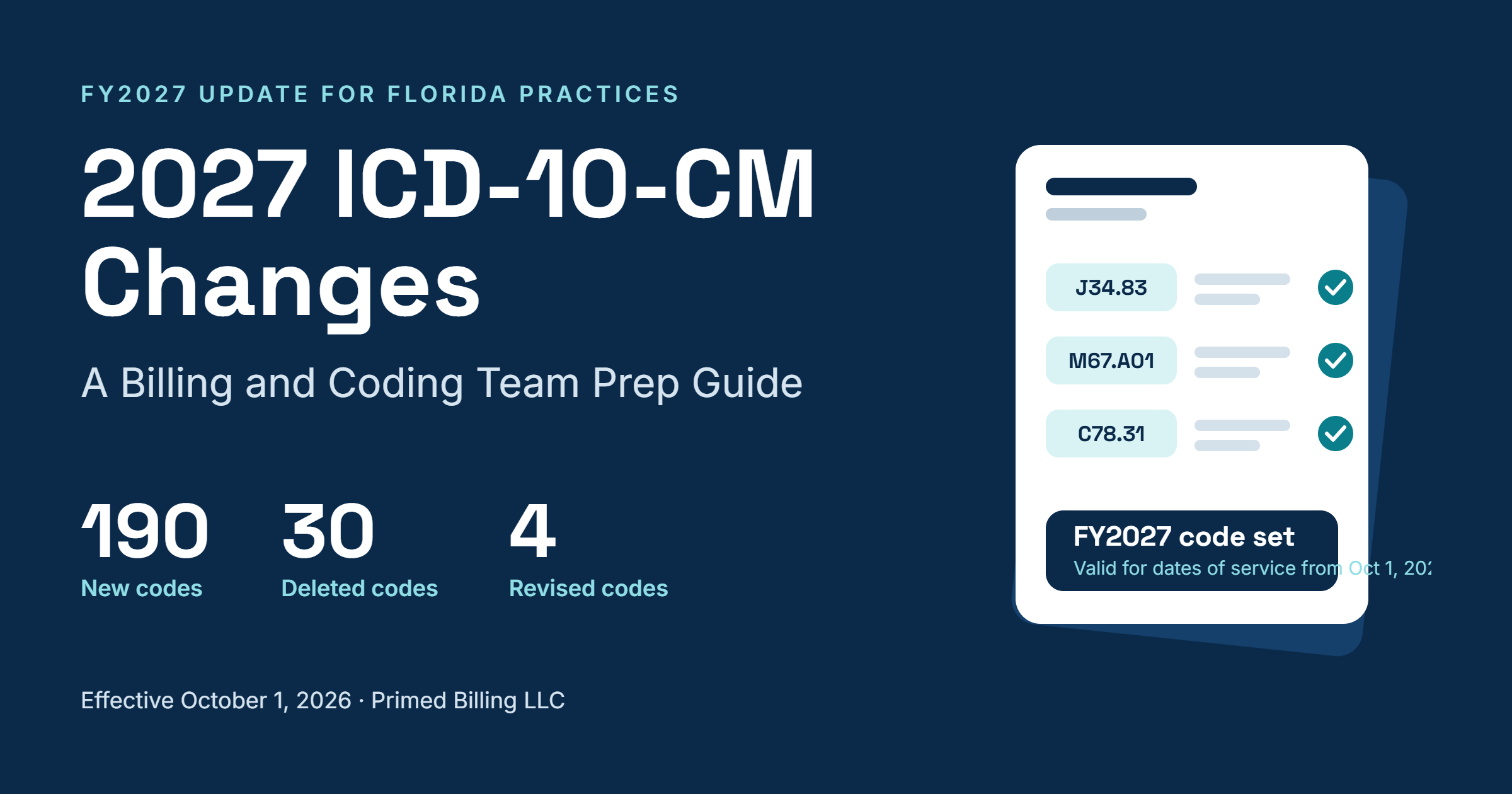
The fiscal year (FY) 2027 ICD-10-CM code set took effect on October 1, 2026, and it applies to patient encounters through September 30, 2027. According to CMS, as reported by the Association of Clinical Documentation Integrity Specialists (ACDIS), the update includes 190 new codes, 30 deleted codes, and four revised codes. Every claim with a date of service on or after October 1 needs a valid FY2027 diagnosis code, and one outdated code can send a clean claim into the denial queue.
This guide, written by the team at Primed Billing LLC, explains what changed, why it matters for Florida practices, and how your billing and coding team can audit its workflow. It also shows how streamlining healthcare management helps practices absorb code updates without losing revenue.
Key Takeaways for Florida Billing and Coding Teams
- Effective dates: The FY2027 code set runs from October 1, 2026, through September 30, 2027.
- Size of the update: CMS published 190 new codes, 30 deleted codes, and four revised codes.
- Which code set to use: Match the code set to the date of service for outpatient claims or the discharge date for inpatient stays.
- What to do now: Update your systems, audit claims submitted since October 1, retrain staff, and track denials weekly.
What Changed in the FY2027 ICD-10-CM Code Set?
ICD-10-CM is the diagnosis code set U.S. providers use to describe why a patient received care. Payers rely on these codes to decide whether a service is medically necessary. The code set is updated every October 1, and CMS released the FY2027 files in June 2026.
Which Code Set Applies to Your Claims?
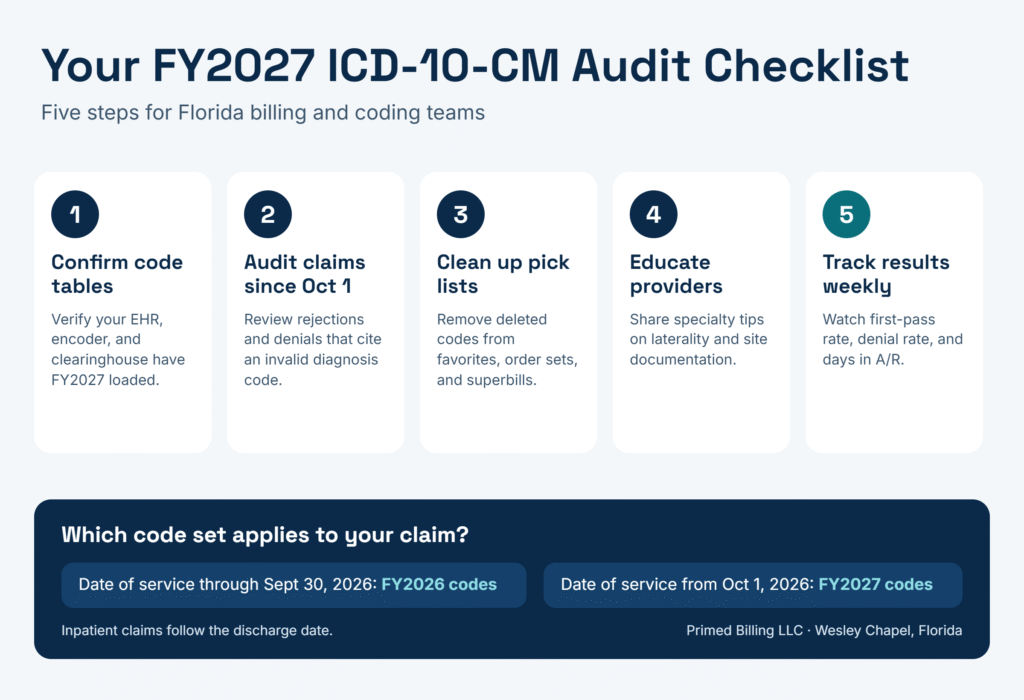
Outpatient and professional claims follow the date of service. Inpatient claims follow the discharge date.
- October 1, 2025 to September 30, 2026: use the FY2026 code set.
- October 1, 2026 to September 30, 2027: use the FY2027 code set.
If a patient was seen on September 28, 2026, and your team bills the claim in mid-October, the claim still uses FY2026 codes.
Notable New and Deleted Codes
The examples below come from the ACDIS summary of the CMS release.
- Pregnancy after vanishing twin syndrome: 33 new codes under category O31.4.
- Toxic effects of cycloparaffins and alkenes: 17 new codes under T52.82, plus the T52.81 series for alkenes.
- Secondary malignant neoplasms: C78.31 (larynx), C78.32 (pharynx), and C79.83 (oral cavity).
- Odontogenic sinusitis: J34.83 with site-specific codes J34.830 through J34.839.
- Plantar fasciitis: M67.A with right, left, and unspecified foot codes.
Many new codes add laterality, anatomical site, or encounter type, so coders cannot assign them unless the provider’s note supports that detail. Among the 30 deleted codes, ACDIS highlights the sternoclavicular sprain series, S23.420 and its seventh-character extensions. Check the Tabular List for current replacements before updating templates.
Why the 2027 ICD-10-CM Changes Matter for Florida Practices
Primed Billing LLC is headquartered in Florida, so this guide focuses on the payers that Florida practices deal with most.
Medicare, Medicaid, and Commercial Payers
Medicare claims in Florida are processed by First Coast Service Options, the Medicare Administrative Contractor for the state. Its billing articles often list the diagnosis codes that support medical necessity, so check for updates that affect your specialty. Florida Medicaid, overseen by the Agency for Health Care Administration, delivers most benefits through managed care plans, and each plan may publish its own claim edits.
PIP Claims and Small Practices
Florida is a no-fault auto insurance state, so many practices bill personal injury protection (PIP) claims. These still require valid diagnosis codes, and a rejection can delay payment for patients waiting on benefits. Small practices feel the pressure most, because one coder often handles everything from eligibility to denial follow-up. That is why medical billing for small practices is a planning issue, not just a staffing issue.
Step-by-Step Prep Guide for Billing and Coding Teams
Treat each step below as an audit if you are reading this after October 1.
Step 1: Confirm Your Software Has the FY2027 Code Tables
Ask your EHR, practice management, encoder, and clearinghouse vendors to confirm the tables are loaded.
Step 2: Audit Claims Submitted Since October 1
Pull every claim with a date of service on or after October 1, 2026. Filter for rejections and denials that cite an invalid diagnosis, then correct and resubmit before each payer’s timely filing limit.
Step 3: Clean Up Pick Lists and Superbills
Remove deleted codes from favorites lists, order sets, and paper superbills.
Step 4: Educate Providers on Documentation
New codes reward specific notes. Share a one-page, specialty-focused summary. A podiatrist should know that laterality now matters for plantar fasciitis, and an ENT should know that sinus location affects the odontogenic sinusitis code.
Step 5: Track Results Weekly
Compare your first-pass acceptance rate, denial rate, and days in accounts receivable against the quarter before October. Weekly review catches problems early.
Streamlining Healthcare Management During Code Updates
Practices that handle code changes well share one trait: their front office, clinical staff, and team work from the same information. Streamlining healthcare management means connecting those pieces so a change in one area does not create errors in another.
- Integrate your EHR and billing system so diagnosis data flows from the chart to the claim with fewer manual entries.
- Verify eligibility before the visit to prevent denials unrelated to diagnosis codes.
- Review your revenue cycle monthly, as covered in our guide to best practices for a successful revenue cycle management.
You can learn more on our page about streamlining healthcare operations.
How a Medical Billing Service Supports Florida Practices
What Primed Billing LLC Offers
Primed Billing LLC is a practice management and revenue cycle company headquartered in Florida that serves practices nationwide. The company reports nearly two decades of experience and offers:
- Full-service medical billing and revenue cycle management
- EHR integration, patient scheduling, reminders, and digital registration
- Back office support, including insurance contracting, credentialing, prior authorizations, and eligibility verification
- Specialty billing for neurology, pulmonary, sleep medicine, vascular, pain management, PM&R, surgery, hospitalist, gastroenterology, radiology, and cardiology practices
The company also states that it follows HIPAA and SOC 2 standards, which matters when a partner handles protected health information.
Medical Billing for Small Practices
A small practice does not need a large in-house department to keep claims moving. A dedicated medical service can monitor code changes, update claim edits, and work denials while your clinicians focus on patients.
Frequently Asked Questions
When did the 2027 ICD-10-CM codes take effect?
The FY2027 code set took effect on October 1, 2026. It applies to outpatient dates of service and inpatient discharges through September 30, 2027.
How many codes changed in the FY2027 update?
CMS published 190 new codes, 30 deleted codes, and four revised codes, according to ACDIS. Third-party tools may count headings differently, so use the official CMS and CDC files as your final reference.
What happens if I submit a deleted or invalid diagnosis code?
The clearinghouse will usually reject the claim, or the payer will deny it as an invalid diagnosis. Correct the code and resubmit before the timely filing deadline.
Is medical billing for small practices better handled in-house or outsourced?
Either can work. A small practice can manage updates itself with trained staff, current software, and time to audit claims. Many practices turn to a medical billing service for coding review and denial follow-up during busy periods.
How can we help with ICD-10-CM updates?
We provide revenue cycle management, EHR integration, scheduling support, and back office services. The team can review your claim data, support denial follow-up, and help align your workflow with the FY2027 code set.
Conclusion
The FY2027 ICD-10-CM update is live, and its 190 new codes, 30 deleted codes, and four revised codes affect many specialties. Update your tables, audit claims from October 1 forward, train providers on documentation detail, and review denials weekly. Streamlining healthcare management through clean data and connected systems keeps denials low all year, not just in October.


